


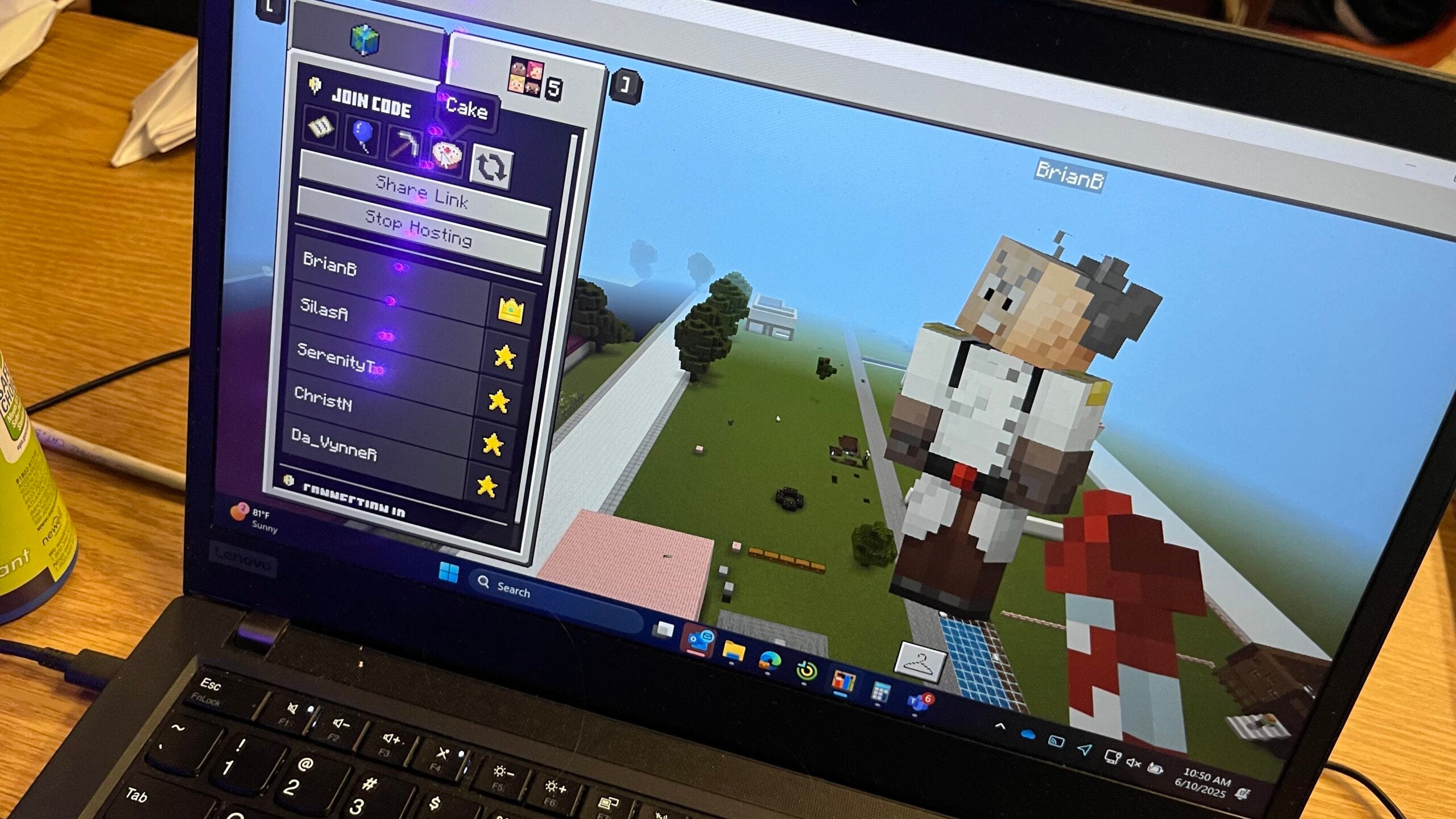
We know games are a powerful way to reimagine urban space and mobility systems. But what if cities started building more playful and accessible spaces inspired by the imagination of kids? That’s the question the New Urban Mobility Alliance (NUMO) asked as they planned a workshop for 49 fifth graders at Frances Scott Elementary in Spokane, Washington.
Minecraft is a 3D open canvas “sandbox game” that allows users to access a wide range of materials to build anything they want — limited only by imagination. More than a game, Minecraft can be used as a tool to engage populations who historically have not been included in urban planning, like children. Rather than interviewing or surveying residents about what they envision in their cities, Minecraft allows them to build and model it themselves.
In June 2025, NUMO experts adapted the United Nations Block by Block Playbook — a methodology that utilizes the popular game Minecraft to transform public spaces — to support students to rethink an empty lot adjacent to their school, their schoolyard and the streets surrounding their school building.
Reconnecting Spokane’s East Central Neighborhood
For the past two years, NUMO has supported Fifth Avenue Forward — a coalition of community organizations, resident leaders, elected officials and city agencies — to reimagine 5th Avenue in Spokane’s East Central neighborhood.
East Central developed as a strong and diverse community of working class and immigrant families in the early 1900s. In 1961, when highways were built across the United States as a result of the Federal Highway Act, construction of Interstate 90 (I-90) split the neighborhood in half, destroying parks, businesses, walkable blocks and more than 650 homes. In addition to the land used for I-90, the Washington Department of Transportation reserved additional land extending one to two blocks past the footprint of the highway (initially used to store construction equipment), that has remained empty for 65 years.
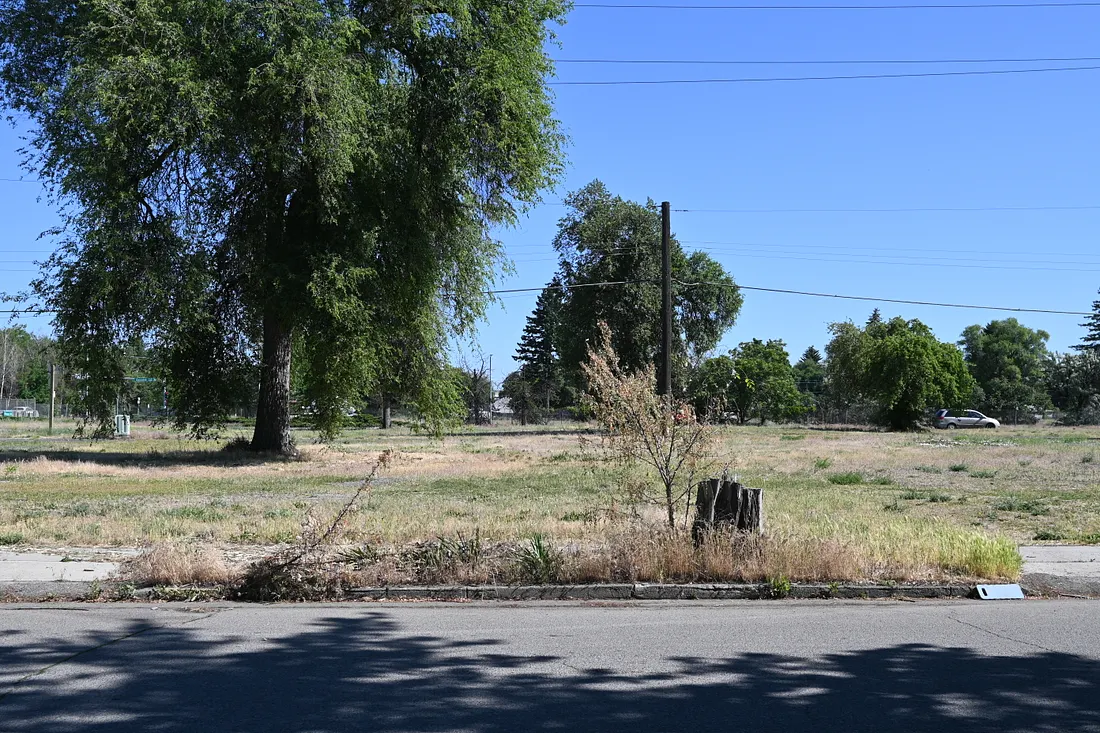
Highway development poses lasting challenges for urban mobility, as cars are prioritized at the detriment of community cohesion and accessibility. In Spokane, I-90’s construction destroyed dozens of formerly walkable blocks, leaving only two viable options for pedestrians to cross I-90. Fifth Avenue Forward seeks to repair past harm from the construction of the highway through two main goals: 1) revitalizing the East 5th Avenue sub-area and 2) reclaiming and redeveloping the vacant lands for the benefit of the community.
Reimagining a Neighborhood With Minecraft
One school in the East 5th Avenue sub-area sits directly by the open land a couple of blocks from I-90: Frances Scott Elementary. At the request of the community and city, NUMO worked with the school to organize a youth engagement workshop to envision what could go on these lands.
Part of a collaboration with the Carl Maxey Center and the City of Spokane Planning Department through the Community Connectors Program (a partnership between NUMO, Smart Growth America, Equitable Cities and America Walks funded by the Robert Wood Johnson Foundation), the workshop was inspired by NUMO’s broader work on games and joyfulness, as well as a participatory planning project that garnered seven thousand proposals to redesign a major avenue in Bogotá, Colombia.
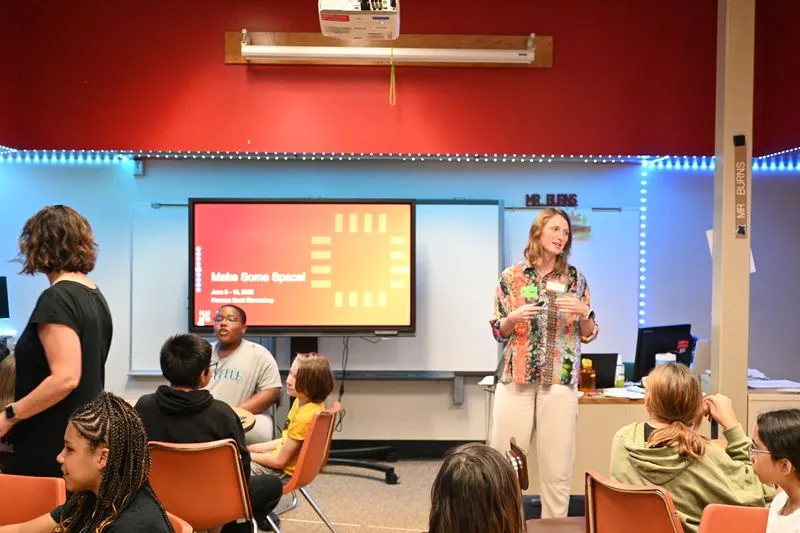
NUMO kicked off the two-day workshop, titled “Make Some Space!” with a site visit to understand existing conditions. Afterwards, the kids quickly started bouncing ideas off each other in a visioning session. Workshop leaders Carlos Felipe Pardo and Justyn Huckleberry asked students what adjectives they wanted to be able to use to describe the spaces they were re-imagining. Their vision was to create spaces that are spacious, incredible, fun, divine, awesome, joyful, colorful, amazing, green, unique, safe and community-oriented.
NUMO experts utilized the remainder of the workshop’s first day to teach students the basics of Minecraft and introduce the shareable Minecraft “world” they built of Spokane’s East Central neighborhood, including Frances Scott Elementary school and the empty lot adjacent to it. With 179 million active players per month and a recent blockbuster movie adaptation, most of Frances Scott Elementary’s fifth graders were already familiar with Minecraft. As such, students quickly grouped up (in pairs of two and four) to begin redesigning their neighborhood. Some students, self-proclaimed Minecraft “wizards,” stepped in to help their fellow designers (classmates) with more difficult tasks in Minecraft.
On the first day, students had free reign of the Minecraft platform to let their imaginations run wild. Held on a summer day in Spokane nearing 95 degrees F, students used this unstructured portion of the workshop to focus on how to cool their empty lot. As a result, multiple teams of students used Minecraft to design three pools. Debriefing the day, students agreed that the open space had sufficient swimming opportunities but would still need other amenities like a hotel, café and garden — setting the stage for structured design time the next day.
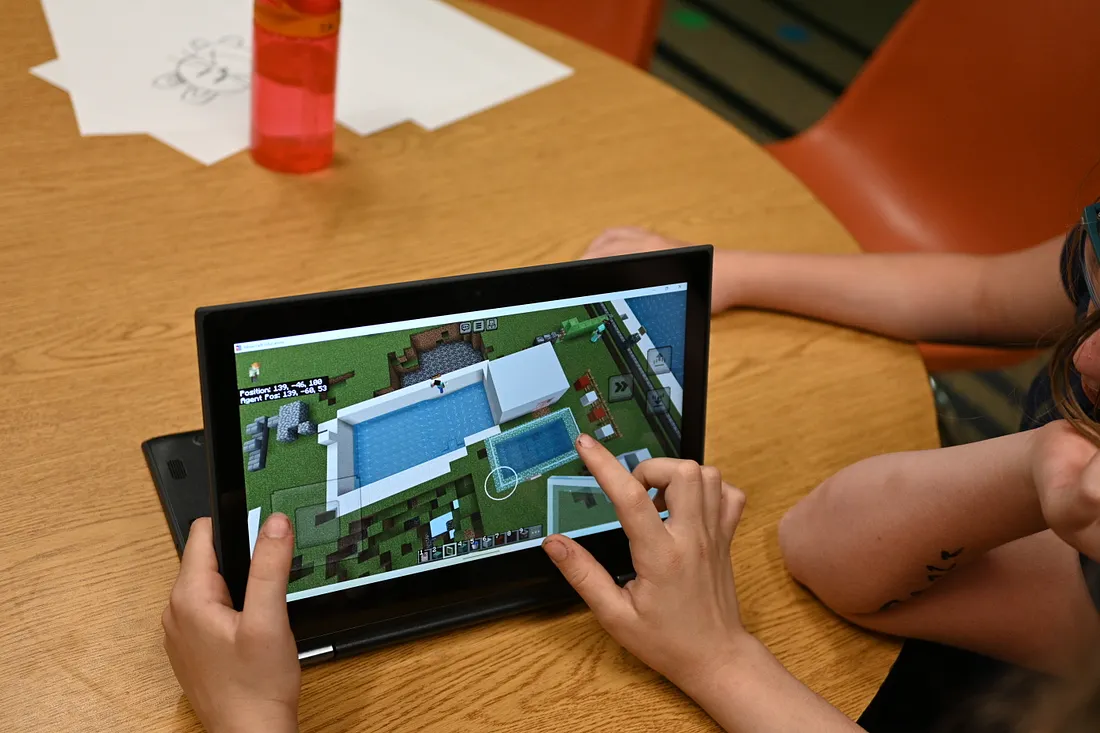
As students engaged with Minecraft, NUMO experts encouraged the class to 1) think about how physical spaces are planned and designed; 2) identify and analyze community needs; 3) work collaboratively; 4) learn about urban design; and 5) express their ideas creatively. Throughout the workshop, students learned how to create more sustainable urban spaces — even learning technical details such as how wide sidewalks must be to be considered accessible and how much parking needs to be built to accompany active mobility infrastructure.
By the end of the two-day workshop, students had developed ambitious designs in Minecraft for the empty land across from their school, including a rocket launch pad, café, community garden, axolotl pond, pedestrian bridge, rest area, “K-pop kitty store,” apartment building, hotel, and three pools with facilities and stadium seating. Designs like the pedestrian bridge reflect the student’s understanding of unsafe road crossings.
Connecting Students With Local Leaders
Throughout the workshop, city and community leaders joined to offer insightful reflections on the planning process. These reflections included level-setting with the children about the complexity of the process, highlighting the red tape at each step — from conception to construction — to make their designs a reality.
Spokane Planning Director Spencer Gardner joined the workshop to ask the students what the most challenging part of their design work was. Many noted that, at times, others were in the way of what they wanted to do. This insightful reflection elicits what many urban planners know well: there are often conflicting views in the planning process.
Workshop volunteers also delicately connected the students’ design work to the fraught history of highway-induced displacement. Chauncey Jones, a community liaison, poignantly highlighted that the empty land the kids were working with was expropriated from the community decades ago.
Including Joy in Urban Design
We need more innovation, creativity and joyfulness in the way we design our urban spaces. Youth participation in urban planning and design is one way to bring fresh perspectives to long-standing problems. Games such as Minecraft provide a stimulating channel for students to get involved and stay engaged in re-imagining the spaces they experience every day.
While Spokane does not currently have plans to implement the designs generated by Frances Scott Elementary School’s fifth graders, their designs garnered insights that can be utilized in broader community planning efforts. The three pools may not be realistic, but they do highlight community desire for more connectivity and accessible recreational activities. Representatives from the school, community and city agreed that they would like to bring the workshop to additional community groups to further engage children and parents across Spokane.
Fifth Avenue Forward and Frances Scott Elementary School are excited to continue the partnership sparked by NUMO’s workshop. Ideas include an urban planning club and finding ways to deepen the connection between the school, the community and the urban fabric of their neighborhood.
This article originally appeared on The New Normal — The NUMO Blog.
Justyn Huckleberry is Projects & Research Associate for NUMO at WRI Ross Center for Sustainable Cities.
Carlos Felipe Pardo was Senior Advisor for NUMO at WRI Ross Center for Sustainable Cities.
Jyot Chadha is Deputy Director of NUMO at WRI Ross Center for Sustainable Cities.