
Yesterday, The City Fix wrote about the winners of the 2009 Buckminster Fuller Challenge, a design competition to “support the development and implementation of a strategy that has significant potential to solve humanity’s most pressing problems.”
At The City Fix, we were interested in sustainable transport ideas, so it was nice to hear that MIT students took home the top prize for their electric vehicle-sharing program. But one of the “honorable mention” teams also caught our eye for their socially responsible “pedal-powered” initiative to merge the use of recycled bicycles with healthcare delivery in rural East Africa, particularly Uganda. Read the rest of this entry »
Student competitions like Urban SOS gather ideas from students around the world about how to confront problems of urban mobility.
There’s been a lot of news this week about students designing a future of sustainable mobility. (Andrew Revkin from The New York Times calls these types of forward-thinking young people part of Generation E.)
From engineering cars of the future to fixing urban sites in disrepair, young people around the world offer up their ideas for creating sustainable cities. Read the rest of this entry »
Supercities will “radically redefine the world’s future macroeconomic and cultural landscape.” But how do you make sense of it all? Image via 192021.org
Some of the greatest minds of design and marketing are working on a five-year, multimedia project to collect information about the rise of urban populations to better understand its impact on urban and business planning and its effect on consumers.
The project is known as 19.20.21, based on the premise that there will be 19 cities in the world with populations of 20 million people in the 21st century. You can learn more about it online in a spiffy Flash-based presentation:
Galen Lawson, EMBARQ’s print designer from Communications Visual, passed along this neat film about an advertising campaign in Sweden which urged drivers to step out from behind the wheel and take the bus.
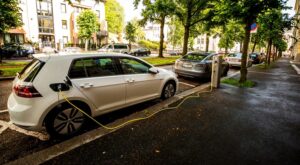
According to Lee Schipper, “a battery supplying the 40-mile range of the GM Volt is said to cost $20,000.” Photo by EuroTraveler.
Lee Schipper, senior fellow at EMBARQ and senior research engineer at the Precourt Energy Efficiency Center of Stanford University, makes the case for more fuel-efficient gasoline cars in the short-term, even though electric cars are more valuable and use less resources.
The main problem with battery electric vehicles, Schipper points out, is a matter of cost. Read the rest of this entry »
The coolest thing about Zipcar’s new FastFleet service isn’t the technology–it’s the buzz. Photo by dominiccampbell.
In response to yesterday’s post about Zipcar’s launch of FastFleet, a municipal fleet management service, Clayton Lane, the chief operating officer of EMBARQ and co-founder of PhillyCarShare, shares his opinion about what’s new and why we should care.
The Story is the Story
By Clayton Lane
Chief Operating Officer
EMBARQ - The World Resources Institute Center for Sustainable Transport
This is a great PR “win” for sustainable transportation. But the real innovation here isn’t the cool technical solution, which is very “2004.” It’s the buzz. Zipcar and D.C. are recycling a truly sustainable solution and making a big fuss about it. For that, they deserve our compliments. Read the rest of this entry »
Zipcar launches pilot program to lease fleet management technology to D.C. government vehicles. Photo by katmere.
The latest car-sharing model to hit the streets could save millions of taxpayer dollars, reduce pollution, and make it easier to beat the morning commute.
The one-of-a-kind service is called FastFleet, a new fleet management system designed specifically for the municipal and federal sector. And it’s run by Zipcar, the largest car-sharing company in the world. Read the rest of this entry »
The world’s first Urban EcoMap combines the social networking capabilities of Facebook with the geographical data of Google Maps to help urbanites reduce their carbon emissions. Image via Urban EcoMap.
Just in time for Earth Day last week, Cisco IBSG and San Francisco’s Department of the Environment unveiled Urban EcoMap, a Web-based tool that “provides urban communities with relevant data regarding the primary [greenhouse gas] contributors—transportation, waste, and energy.”
Working off the idea that knowledge is power, the tool intends to build awareness about climate change so that urban dwellers will take action to reduce their carbon emissions, as well as to support decision-making for policymakers, businesses, and other people involved in urban design and development. J.D. Stanley from Cisco describes this process as “digital swarming,” or “an approach that blends elements of social networking with human networking and with emerging capabilities provisioned through digital fabrics.” Read the rest of this entry »
Bicycling is not just for born-to-be-bad renegades. Photo by laureskew.
Kyle Boelte published an article in The Christian Science Monitor entitled “The Soul (and Sense) of Biking to Work.” While he makes both a wonderful, practical, and emotional appeal to would-be commuter bikers - which I am all for - he discusses biking as if it were a renegade counter-culture. This is, I understand, the case for some bikers, who like the feeling of defying cars, which Boelte calls “metal beasts of burden.”
But there are also those who like to feel the satisfaction of altruism in the form of burning leg muscles rather than fossil fuels. And there are those scrimpers and savers who have joyously come out of the closet now that championing thrift has become cooler. There are also those who are learning - or have been forced to learn - to find ways to cut $$$ corners. These too have opted for the bike in some cases. (As for me, I cut back on the Starbucks lattes and take the metro to work more often.)
Nevertheless, the joy and economic appeal that Boelte extols in his ode to renegade biking will be short-lived if we don’t make more permanent changes. Most people are not renegades for long, although they might play with fire from time-to-time just to test the water. And what goes down must go up: the economic recession won’t last forever. Read the rest of this entry »
Open-source technology is required to develop competitive sustainable urban transport systems. Photo by B.J. Allen.
Robin Chase, one of The City Fix bloggers and founder and former CEO of Zipcar, says that “open technology” is a key part of making intermodal transportation a reality.
“Users (people or freight) need to know the schedules, requirements, and opportunities, need to book capacity and to make payments seamlessly, not only between modes but between states and perhaps countries as well,” she says as part of an online panel for the National Journal’s transportation blog.
So what does “openness” mean for different technology platforms, information, devices, and networks? Read the rest of this entry »
Recent Comments